Sequence of Returns Risk: The Hidden Threat to Pension Drawdown (And How to Manage It)
Two retirees with identical average returns can end up worlds apart — one comfortable, the other running out of money. Here's why timing matters in drawdown, and what you can do about it.
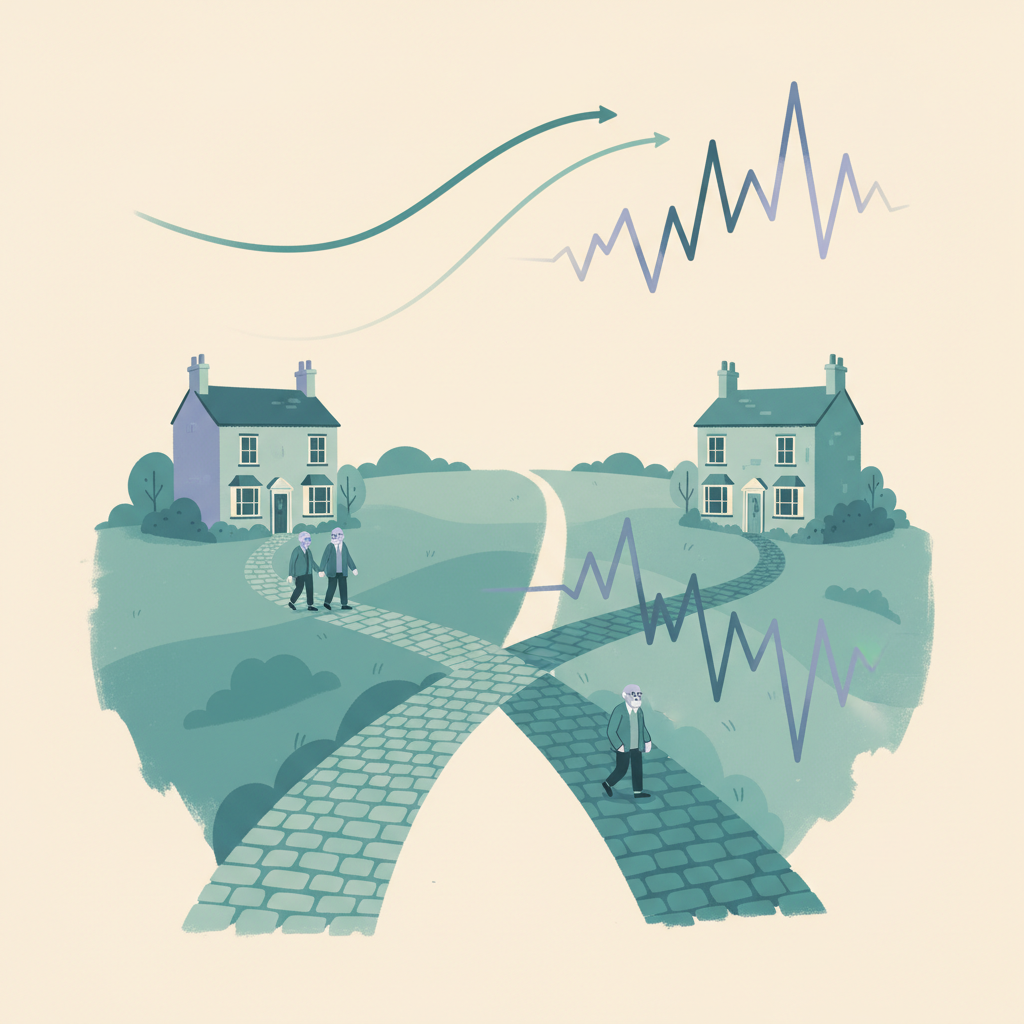
Imagine two retirees, both with a £400,000 pension pot, both withdrawing £20,000 a year, both achieving an average annual return of 5% over 25 years. Logic says they should end up in roughly the same place. In reality, one might run out of money before age 80, while the other dies with a healthy six-figure balance.
The difference isn't skill, luck, or even the average return. It's the order in which those returns happen — what advisers call sequence of returns risk. It's arguably the single most important concept to understand once you start drawing income from a pension, and it gets surprisingly little airtime compared with topics like fees or tax.
What is sequence of returns risk?
During the accumulation phase — when you're paying into your pension — the order of investment returns barely matters. A bad year early on is a buying opportunity; markets recover and your pot grows. The maths is forgiving because you're not selling units to fund your lifestyle.
Once you start drawing an income, everything changes. Now, every withdrawal you make in a falling market locks in losses and removes capital that can't recover when markets bounce back. A few bad years at the start of retirement can devastate a portfolio that would otherwise have lasted decades.
This is sequence of returns risk in a nutshell: the same average return can produce wildly different outcomes depending on whether the bad years come early or late in your drawdown journey.
A practical example: meet Sarah and David
Both retire at 65 with £400,000. Both withdraw £20,000 (5% of the starting pot) each year, increased by 2.5% inflation annually. Both achieve the same 5% average return over 20 years. The only difference is the order of their returns.
Sarah — bad years first
Sarah has the misfortune of retiring just before a market downturn. Her first three years deliver returns of -15%, -8%, and -5%, before recovering. Even though her later years are strong, those early withdrawals during a falling market eat into her capital permanently.
By year 15, Sarah's pot is under serious pressure. By year 20, she has effectively run out of money — despite achieving a perfectly respectable 5% average return.
David — good years first
David retires into a bull market. His first three years deliver returns of +18%, +12%, and +9%, before later years turn negative. Even with the same withdrawals and the same average return, David's pot grows substantially in those early years and creates a buffer that absorbs the later downturns.
By year 20, David still has well over £200,000 left.
Same starting pot. Same withdrawal pattern. Same average return. Vastly different outcomes — purely because of when the bad years arrived.
Why early retirement is the most dangerous window
The first 5 to 10 years of drawdown are sometimes called the "fragile decade" or "retirement red zone". This is when sequence risk is at its peak, for two reasons:
- Your pot is at its largest. A 20% market fall on a £400,000 pot is an £80,000 paper loss. The same percentage fall on a £150,000 pot in your 80s is far less consequential in absolute terms.
- You haven't yet "banked" any of your retirement. If markets fall in year 20 of retirement, you've already enjoyed two decades of income. If they fall in year 1, every pound you withdraw is coming out of a smaller pot at a worse price.
Research from various UK and US studies consistently shows that the returns achieved in the first decade of retirement have a disproportionate impact on whether your money lasts. Get those years right and you have enormous flexibility. Get them wrong and you may need to make uncomfortable adjustments later.
How to manage sequence of returns risk
You can't control markets, but you can build a drawdown strategy that's resilient to whatever sequence you happen to land in. Here are the most widely used approaches.
1. Hold a cash buffer
Keeping 1-3 years of essential spending in cash or near-cash investments means you don't have to sell equities during a downturn. When markets fall, you draw from cash; when they recover, you replenish the cash buffer from the rebounded portfolio.
On a £400,000 pot funding £20,000 of annual income, that might mean holding £20,000–£60,000 in a money market fund or cash savings. It's not a guarantee, but it dramatically reduces the chance of selling at the worst possible moment.
2. Use a dynamic (variable) withdrawal strategy
Rather than rigidly increasing withdrawals each year, dynamic strategies adjust spending based on portfolio performance. Approaches such as the Guyton-Klinger rules tell you to skip an inflation increase, or even reduce withdrawals slightly, after a poor market year — and to allow yourself a pay rise after a strong one.
Even small adjustments early on can substantially extend portfolio longevity. Cutting withdrawals by 5–10% during a bear market may feel uncomfortable, but it's far better than running out of money in your late 80s.
3. Consider a "rising equity glide path"
Conventional wisdom says you should de-risk as you age — more bonds, less equity. But some research suggests doing the opposite in retirement: starting with a slightly more conservative allocation (say, 50% equities) and gradually increasing equity exposure over time.
The logic is that this reduces equity exposure in the most dangerous window — the first decade — while still capturing long-term growth. It's not for everyone, and it requires a strong stomach, but it's a credible answer to sequence risk.
4. Use a bucket strategy
The classic three-bucket approach segments your pot by time horizon:
- Bucket 1 (1-2 years of income): Cash and money market funds — for immediate spending.
- Bucket 2 (3-7 years of income): Bonds and lower-risk multi-asset funds — to refill Bucket 1 in normal markets.
- Bucket 3 (8+ years): Equities and growth assets — for long-term inflation-beating returns.
You only ever sell equities (Bucket 3) when markets are healthy, giving the long-term portion time to recover from any downturn.
5. Layer in guaranteed income
Securing some of your essential spending with guaranteed income — your State Pension, plus potentially a lifetime annuity or fixed-term annuity — removes that portion from sequence risk entirely. The smaller the proportion of your essentials that depends on portfolio performance, the less damage a poor sequence can do.
For example, if your State Pension covers £11,500 of a £25,000 essential budget, you only need £13,500 from your drawdown pot. That's a much more sustainable starting point than relying on the pension for every penny.
Warning signs that sequence risk is biting
If you're already in drawdown, watch for these red flags:
- Your pot is meaningfully smaller in real terms after 2-3 years than when you started — and you're still withdrawing the same amount.
- Your withdrawal rate has crept above 5-6% of the current pot value, even though you didn't intend to increase it.
- You're selling growth assets to fund income during a market downturn rather than drawing from cash or bonds.
- You haven't reviewed your plan in over 12 months.
None of these are catastrophic on their own, but together they suggest your drawdown strategy may need a rethink before things get worse.
Stress-testing your plan
One of the most useful exercises is to model what would happen to your plan if you experienced a 2008-style crash in your first year. Most retirement planning tools — including our own retirement planner and drawdown calculator — let you adjust assumptions to see how a poor early sequence would affect your pot.
If the answer is "I'd run out of money in my 80s", you may want to consider lowering your initial withdrawal rate, building a bigger cash buffer, or using guaranteed income to cover essentials. If the answer is "I'd be uncomfortable but fine", you have a more resilient plan than most.
Key takeaways
- Sequence of returns risk is the danger that poor investment returns early in retirement permanently damage your pot, even if average returns over your full retirement are healthy.
- The first 5-10 years of drawdown — the "fragile decade" — is when this risk is greatest.
- Two retirees with identical average returns can end up with wildly different outcomes depending on the order of those returns.
- Practical defences include holding a cash buffer, using dynamic withdrawals, considering a rising equity glide path, adopting a bucket strategy, and securing essential spending with guaranteed income.
- Stress-testing your plan against a poor early sequence is one of the most valuable things you can do before — or shortly after — starting drawdown.
Sequence of returns risk is one of those concepts that's easy to ignore in good markets and impossible to ignore in bad ones. Building it into your thinking from day one of retirement means you're not relying on luck.
If you'd like to see how different drawdown providers compare on the features that help manage this risk — cash funds, model portfolios, flexible income options and reasonable charges — try our provider comparison tool. And as always, this article is general information rather than personal advice; for guidance on your individual circumstances, it's worth speaking to a qualified adviser who can stress-test your plan against your own goals and risk tolerance.
Further reading: Sequence of Returns Risk in Pension Drawdown: Why Timing Matters More Than Average Returns
What Is Sequence of Returns Risk?
Sequence of returns risk is one of the most important — and least understood — dangers facing people in pension drawdown. It refers to the impact that the order of investment returns has on your retirement wealth, particularly when you are regularly withdrawing income from your portfolio.
In simple terms: a market crash early in retirement is far more damaging than the same crash happening later. Even if the average return over 20 years is identical, two retirees can end up with very different outcomes depending purely on when bad years occur. This is sequence of returns risk — and understanding it is essential for anyone using pension drawdown.
Why the Order of Returns Matters
During your accumulation years (when you're saving), sequence of returns risk exists but is manageable. Bad years mean you're buying units cheaply, and you have time for markets to recover. You're not selling anything.
In drawdown, everything changes. You're now a net seller — you're drawing money out regularly. If markets fall sharply in the early years of retirement, two things happen simultaneously:
- Your portfolio value drops (losses on existing units)
- You sell more units to fund the same income (because each unit is now worth less)
This double-hit means you're selling a larger proportion of your portfolio at depressed prices. Even when markets recover, you have fewer units to benefit from the bounce. The portfolio never fully recovers to what it would have been without early losses — even with identical average returns over the full period.
A Concrete Example
Consider two retirees — Sarah and David — both starting with £300,000 and withdrawing £15,000 per year. Over 10 years, both portfolios average 4% annual returns. But the order of those returns differs:
- Sarah: Experiences strong returns in years 1–5, then a crash in years 6–10
- David: Experiences the crash in years 1–5, then strong returns in years 6–10
Despite identical average returns, David — who faced the crash early — could exhaust his portfolio significantly sooner than Sarah. This is because Sarah accumulated a larger pot during the good early years before the drawdown withdrawals compounded the losses.
This isn't theoretical: retirees who retired in 1999 (just before the dot-com crash) faced sequence risk immediately, while those who retired in 2003 (at the bottom) had early gains that cushioned later turbulence.
Who Is Most Vulnerable to Sequence Risk?
Sequence of returns risk is most acute in the first 10 years of drawdown. This is sometimes called the "fragile decade" — the period when portfolio losses do the most long-term damage. After roughly 10–15 years, a portfolio that has survived early drawdown often has enough momentum (assuming reasonable returns) to sustain withdrawals.
You are particularly vulnerable to sequence risk if:
- Your entire retirement income comes from invested drawdown (no guaranteed income to fall back on)
- You are withdrawing a high percentage of your portfolio each year (above 4–5%)
- You have a heavily equity-weighted portfolio with high volatility
- You have no cash buffer and are forced to sell investments whatever the market conditions
- You retire at or near a market peak
Six Strategies to Manage Sequence of Returns Risk
1. Build a Cash Buffer (The Bucket Strategy)
Holding 1–2 years of essential spending in cash means you never have to sell investments at the worst moments. If markets fall, you draw from the cash bucket while waiting for recovery. This is the most direct defence against sequence risk.
2. Reduce Withdrawal Rates in Down Years
A flexible withdrawal strategy — sometimes called a "guardrail" approach — involves reducing income in years when your portfolio has fallen significantly and increasing it in good years. This requires some lifestyle flexibility but dramatically reduces the risk of running out of money.
For example: if your portfolio falls more than 20%, you might reduce withdrawals by 10% for that year. This slows the rate at which you're selling cheap units and gives the portfolio more chance to recover.
3. Use Guaranteed Income as a Floor
If part of your retirement income comes from guaranteed sources — State Pension, defined benefit pension, or an annuity — you reduce your dependence on volatile investments for day-to-day living. Your essential expenses are covered regardless of market performance, and you only draw from investments for discretionary spending.
Many advisers recommend structuring drawdown so that guaranteed income covers essential spending, with invested drawdown providing "top-up" income. This naturally limits sequence risk because you can afford to draw less from investments when markets are down.
4. Delay Taking Full Drawdown
Some people use a period of part-time work, rental income, or ISA savings in the early years of retirement, delaying full drawdown by a few years. This has two benefits: it reduces the number of years you draw from the portfolio, and it can allow the pension to grow a little longer before you rely on it entirely.
Similarly, if your State Pension starts in a few years, you might bridge the gap with other savings rather than heavy drawdown, reducing your exposure to sequence risk in that transition period.
5. De-Risk Your Portfolio as You Enter Drawdown
Some advisers recommend holding a more cautious investment mix (more bonds, less equities) in the first 5–10 years of drawdown, then potentially increasing equity exposure later when the "fragile decade" has passed. This smooths returns and reduces the chance of a severe early loss.
The trade-off is lower expected long-term growth — which matters if you have a long retirement ahead. A financial adviser can help model the right asset allocation for your specific circumstances, retirement age, and risk tolerance.
6. Consider a Partial Annuity
Using part of your pension to purchase an annuity creates a guaranteed income floor that reduces how much you need to draw from your invested pot. This is sometimes called an "annuity ladder" — buying annuities at different life stages as annuity rates (which tend to improve with age) become more attractive.
Even a small annuity that covers essential bills can meaningfully reduce sequence risk by ensuring you draw less from investments in down years.
Sequence Risk and the Safe Withdrawal Rate
The concept of a "safe withdrawal rate" — often cited as 4% in the UK context — is directly linked to sequence of returns risk. The 4% figure was derived from historical analysis asking: what withdrawal rate would have survived even the worst sequences of returns over 30-year periods?
In practice, a 4% withdrawal rate works on average but does not guarantee success in every sequence scenario, especially if you:
- Retire at a market peak
- Have a longer-than-30-year retirement
- Have a portfolio heavily weighted towards one asset class or geography
Sequence of returns risk is the primary reason why a "safe" withdrawal rate has to be set conservatively — it's not just about average returns, but about surviving the worst-case ordering of those returns.
Monitoring and Reviewing Your Drawdown Plan
Sequence risk isn't a one-time concern — it requires ongoing monitoring. Most advisers recommend an annual drawdown review that considers:
- Current portfolio value vs projections
- Withdrawal rate as a percentage of current pot (if this is rising, it may signal a need to reduce withdrawals)
- Market conditions and whether any rebalancing is needed
- Whether your guaranteed income (State Pension, DB) has started yet
- Whether your spending needs have changed
If your portfolio has fallen significantly in the early years of drawdown, proactive action — reducing discretionary spending, drawing on ISAs instead of pension, or even part-time work — can make a substantial long-term difference.
Key Takeaways
- Sequence of returns risk means a market crash early in retirement causes far more damage than the same crash later
- The early years of drawdown (the "fragile decade") are when you are most vulnerable
- A cash buffer prevents forced selling at market lows — the simplest and most effective defence
- Flexible withdrawal strategies, guaranteed income floors, and partial annuities all help manage the risk
- Regular annual reviews allow you to catch and respond to sequence risk early
This article is for educational purposes only and does not constitute financial advice. Pension drawdown involves investment risk and income is not guaranteed. Individual circumstances vary significantly — speak to a qualified financial adviser who can model sequence risk specific to your situation and help you build a sustainable drawdown plan.
Further reading: Understanding Sequencing of Returns Risk in Pension Drawdown
Understanding Sequencing of Returns Risk in Pension Drawdown
For those entering retirement and opting for pension drawdown, managing investment risk becomes a crucial consideration. One particular risk that often gets less attention than market volatility itself, but can have a profound impact, is "sequencing of returns risk." This article delves into what this risk entails, why it matters, and how it can be mitigated.
What is Sequencing of Returns Risk?
Sequencing of returns risk refers to the danger that the order and timing of your investment returns, particularly in the early years of your retirement, can significantly affect the longevity of your pension pot. It's not about the average annual return you receive over your entire retirement, but rather the pattern in which those returns occur.
Imagine two retirees, both starting with the same pension fund and withdrawn amount, and both experiencing the same average annual investment return over 20 years. If one experiences poor returns early in retirement, followed by strong returns later, while the other experiences strong returns early, followed by poor returns, their financial outcomes can differ dramatically. The one who experiences poor returns early on is hit harder because their withdrawals deplete a smaller asset base, meaning there are fewer assets left to benefit from any subsequent recovery.
The Impact of Early Losses
When you are in the accumulation phase (saving for retirement), poor market returns can be seen as an opportunity. Your regular contributions buy more units when prices are low. However, in the decumulation phase (drawing an income), poor returns, especially when combined with regular withdrawals, can be devastating. Each withdrawal locks in a loss, permanently reducing the asset base. This means that a fund suffering early losses needs significantly higher subsequent returns to recover and support the same income level compared to a fund that experienced early gains.
Why is it Particularly Relevant for Pension Drawdown?
Pension drawdown, by its very nature, exposes retirees to this risk more than traditional annuities. With an annuity, your income is guaranteed regardless of market performance. With drawdown, you remain invested, giving you the flexibility to manage your income and potentially grow your fund, but also exposing you to investment risks, including sequencing risk.
The flexibility of drawdown—being able to choose how much and when you take an income—also highlights the importance of managing this risk. Taking higher withdrawals during a period of market downturn will exacerbate the problem, accelerating the depletion of your fund.
Example Scenario: The Early Retirement "Bad Luck"
Consider a retiree who draws an income during a market downturn shortly after retiring. Their portfolio falls in value, and each withdrawal takes a larger percentage of the remaining fund. If the market then recovers, their smaller fund has less capital to benefit from the rebound. Conversely, a retiree who enjoys strong market performance early on can build a larger capital base, making their fund more resilient to future downturns.
Strategies to Mitigate Sequencing of Returns Risk
While this risk cannot be entirely eliminated for those in drawdown, several strategies can help to mitigate its impact:
1. Diversification
A well-diversified portfolio across different asset classes (equities, bonds, property, alternatives) can help smooth out returns and reduce the impact of a downturn in any single market segment. Diversification doesn't guarantee against losses, but it can reduce the severity of market fluctuations.
2. Maintaining a Cash Buffer
Many people consider holding a cash buffer, typically equivalent to one to three years' worth of income needs, in an easily accessible account. This allows you to draw income from cash during periods of poor market performance, without being forced to sell investments at a loss. This strategy "rides out" the market downturns, allowing your growth assets time to recover.
3. Dynamic Withdrawal Strategies
Instead of rigid, fixed withdrawals, options include adopting a more flexible approach. This might involve:
- Reduced spending in down years: If investment returns are poor, you might consider temporarily reducing your withdrawals to preserve capital.
- Variable withdrawals based on portfolio performance: Linking your withdrawal rate to your portfolio's actual returns, taking less when returns are poor and potentially more when returns are strong.
- Guardrails approach: Setting upper and lower limits for your withdrawal rate. If your portfolio performs exceptionally well, you might take a little more, but if it performs poorly, you reduce your withdrawals to a minimum.
4. Phased Withdrawal or Blended Approach
Some retirees might consider a phased approach, perhaps purchasing a small annuity in early retirement to cover essential living costs, while keeping the rest of their fund in drawdown. This provides a guaranteed base income, reducing the pressure on the drawdown fund during market downturns. As they get older, they might then purchase another annuity.
5. Regular Portfolio Review and Rebalancing
It's worth exploring regular reviews of your portfolio to ensure it remains aligned with your risk tolerance and objectives. Rebalancing involves selling assets that have performed well and buying those that have underperformed to maintain your desired asset allocation. This can be a disciplined way to take profits and manage risk.
6. Delaying Retirement
For those approaching retirement, if the market experiences a significant downturn, delaying retirement for a year or two, if feasible, can allow more time for the portfolio to recover before income withdrawals begin. This simple approach can sometimes circumvent the worst of early sequencing risk.
The Role of Professional Advice
Navigating the complexities of pension drawdown and sequencing of returns risk can be challenging. A qualified financial adviser can help you understand your options, assess your individual risk tolerance, and develop a robust retirement income strategy tailored to your circumstances. They can help you construct a diversified portfolio, implement appropriate withdrawal strategies, and review your plan regularly to adapt to changing market conditions and personal needs.
It's important to remember that while past performance is not an indicator of future results, understanding the dynamics of sequencing of returns risk is vital for effective long-term financial planning in retirement.
Speak to a qualified financial adviser for personal guidance.